Diagnostics tell prospective tenants about the unit's energy use and safety (installations, materials, local risks). Together they make up the technical diagnostic file attached to the lease.
On your listing, they reassure applicants and avoid pointless visits.
In the console, you enter them once per unit: they appear on the public listing, in the Diagnostics section.
Depends on the country. The obligations below apply in France (at the time of writing; check service-public.fr). In Cameroon, Senegal and most African countries these reports are generally not required: enter the ones you have, they are a sign of professionalism. Without information, the listing states that the landlord has not provided them yet.
The DPE: energy performance
The energy performance diagnostic estimates the unit's energy use (heating, hot water, cooling…) in kWh per m² per year and turns it into a class from A (very efficient) to G.
Class
Use (kWh/m²/year)
A
70 or less
B
71 to 110
C
111 to 180
D
181 to 250
E
251 to 330
F
331 to 420
G
over 420
Mandatory in France for every rental: the energy and climate classes must appear in the listing, with the estimated yearly energy costs.
Valid for 10 years. DPEs carried out before 1 July 2021 are no longer valid.
Energy-inefficient homes: the Climate and Resilience Act gradually bans renting the least efficient units (class G since 2025, F in 2028, E in 2034) and freezes rent increases for F and G units.
The GES label: climate impact
Produced with the DPE, the GES (greenhouse gas) label measures emissions from energy use, in kg of CO2 per m² per year, from A to G.
Class
Emissions (kg CO2/m²/year)
A
6 or less
B
7 to 11
C
12 to 30
D
31 to 50
E
51 to 70
F
71 to 100
G
over 100
On the official report, the DPE class is the worse of the two measurements (energy and climate). Copy the classes shown on your report: they are authoritative.
Other reports
Report
When required (France)
Validity for a rental
Electrical installation
Installation over 15 years old
6 years
Gas installation
Gas installation over 15 years old
6 years
Lead (CREP)
Built before 1 January 1949
Unlimited if no lead, otherwise 6 years
Asbestos
Building permit before 1 July 1997: the private-areas asbestos file is kept available to the tenant
Unlimited if no asbestos
Termites
Required for sales in areas defined by prefectoral order; optional for rentals
6 months (sale)
Risk report (ERP)
Unit located in a risk area (flooding, earthquake, radon, polluted soil…)
6 months
For each one, the console offers three states: Done, nothing to report, Done, issues reported or Not applicable. Leave “Not provided” if you do not know: nothing is shown for that report.
Entering diagnostics in the console
Open the unit page and, under Technical details, click Edit settings.
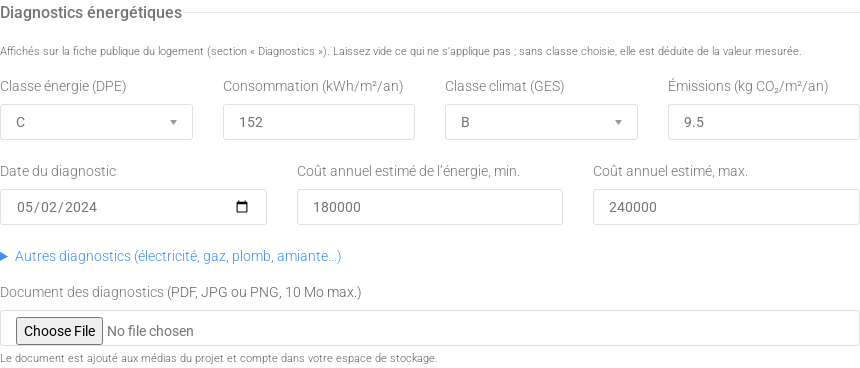
In the Energy diagnostics part, enter the DPE class and energy use, the GES class and emissions, the diagnostic date and, if you have it, the yearly energy cost range.
Expand Other reports to set the state of each one, and add a note if needed.
Attach the diagnostics document (PDF, JPG or PNG, 10 MB max.), then click Save.
Entering diagnostics in the unit settings.
Derived class: if you do not pick a class, it is computed from the measured value.
Document: it is added to the project media and counts towards your storage. A new file replaces the document linked to the unit; the old one stays in the media.
What applicants see
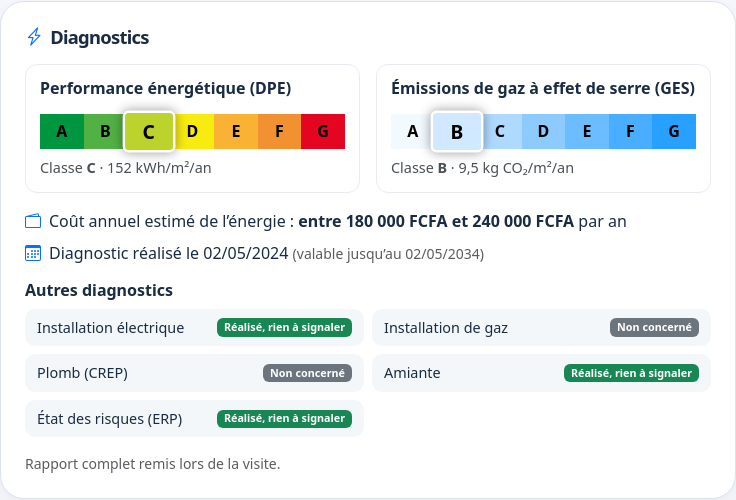
On the public listing, the Diagnostics section shows the DPE and GES scales with the unit's class, the measured values, the estimated yearly energy cost, the diagnostic date with its expiry date, and the state of the other reports.The Diagnostics section on the public listing.
After 10 years, an Expired badge shows the DPE must be redone.
The attached document stays private: it cannot be downloaded from the listing. Give it to the tenant with the lease.
Link copied!
Respect de votre vie privée
Nous utilisons des cookies de mesure d'audience, d'assistance et de publicité (Google Analytics, Highlight, Google AdSense) qui ne sont pas nécessaires au fonctionnement du service. Vous pouvez les accepter ou les refuser.